As Canada accelerates towards its net-zero climate target, carbon capture and storage (CCS) is emerging as a critical part of the solution. The process captures carbon dioxide (CO ) from industrial sources, compresses it and injects it deep underground into geological formations designed to trap the gas permanently.
But permanent storage relies on one crucial factor: ensuring the CO stays put. Once it's injected hundreds of metres below the surface, researchers and regulators must ensure it remains safely contained.
Carleton University environmental engineering PhD student Isabella Hearne is researching how to detect possible leaks before they reach the surface.
The Last Line of Defence
Deep geological CCS builds on decades of oil and gas experience, storing CO in porous rock formations more than 800 metres underground.
While those formations are carefully selected to minimize risk, the gas itself is buoyant, under pressure and naturally seeks to escape. If injection wells are compromised or if fractures, faults or abandoned wells intercepting the formations exist, CO can migrate upwards through layers of soil and rock.
That raises two concerns: potential impacts to overlying groundwater systems and the possibility of CO returning to the atmosphere, undermining its intended climate benefit.
Working with her supervisor Cole Van De Ven in the Geo-Environmental Gas and Contaminants Lab, Hearne studies what happens in the shallow subsurface above deep storage reservoirs an area known as the "critical zone."
Carleton University assistant professor in environmental engineering Cole Van De Ven
"Our research group works in the critical zone, which is that area from the ground surface to the shallow aquifers that we drink from," explains Hearne.
"It acts as the last line of defence. If we're going to catch a leak, this is the last place we can."
To reduce risk, storage projects use multiple monitoring methods. Hearne focuses on near-surface monitoring, which involves using soil gas probes or shallow wells to measure the concentration of gases. The approach is widely used for its relative low cost and ability to cover large areas.
However, microbial activity, plant roots and environmental changes can influence soil gas levels, making it difficult to distinguish between normal fluctuations and warning signs of a leak.
"CO is always changing in our environment," says Hearne.
"We can't just look at sampling data and say, CO is high, it must be a leak.' It needs to be more involved than that."
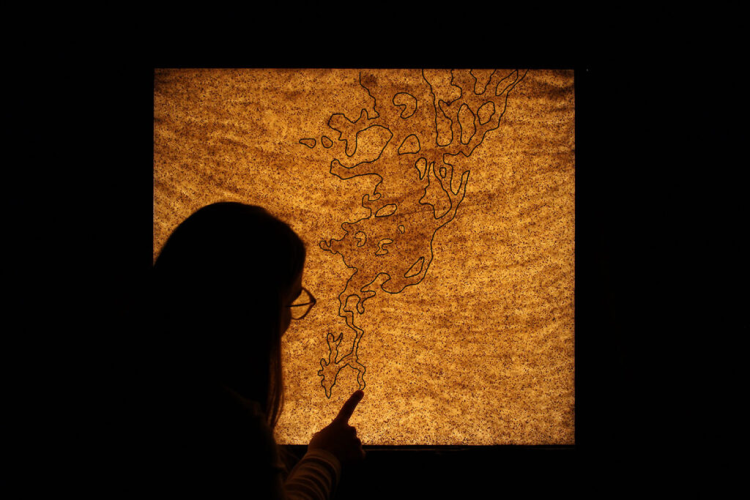
Hearne points out a channel of CO gas flow, outlined in black
A Novel Visualization Technique at Carleton
In controlled lab experiments, Hearne simulates CO leaks to better understand how gas behaves as it moves through soil. Her goal is to refine detection methods and reduce false alarms or missed leaks.
Central to her research is a visualization technique used in only a few labs worldwide, including Carleton. By injecting CO into a transparent sand-filled chamber and using a light-transmission imaging method, Hearne can observe how gas moves underground in real time which can't be seen in field conditions and what most studies instead infer from surface measurements.
"I explain to my friends that it's like an ant farm," says Hearne.
"It's this big box of sand with a light panel behind it and the visible streaks are the flowing gas."
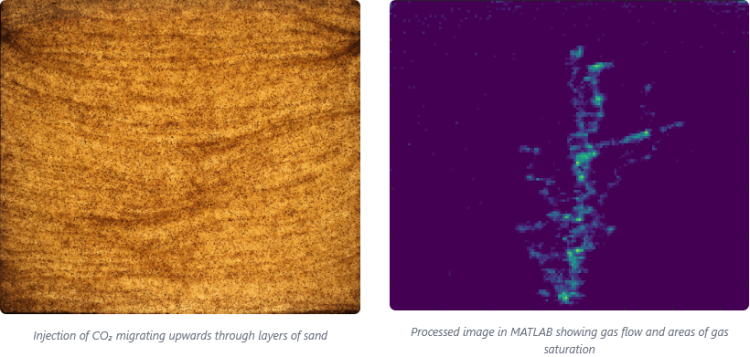
This controlled setup at Carleton allows researchers to link gas movement underground with what's measured at the surface, enabling more reliable testing of how leaks are detected.
Building on those observations, Hearne studies how leaking gas affects the mix of gases in the soil, rather than relying on CO concentrations alone. She also tests how reliable these monitoring methods are under varying leak rates and soil conditions.
The result is a clearer picture of how carbon behaves underground and an improved ability to detect leaks early.
From the Arts to Environmental Impact
Hearne never expected to study environmental engineering, let alone conduct climate mitigation research in a lab.
"All my life I was an arts person," says Hearne.
"Nobody would have ever guessed I would end up in engineering, including me."
That shift began in grade 11 chemistry. Her teacher who blended creativity with science introduced the class to the film Erin Brockovich.
"I saw the movie and thought, that's something I could do," recalls Hearne.
"I was seeing the effects of climate change everywhere and wanted to do something to change things."
Science and engineering offered a way to turn that concern into action.
She initially majored in aerospace engineering but switched programs after learning about the range of work in environmental engineering, such as air pollution control and soil remediation to water treatment and waste management.
Hearne hopes her research will strengthen monitoring standards and reinforce that last line of defence in deep geological CCS, supporting broader efforts to reduce emissions.