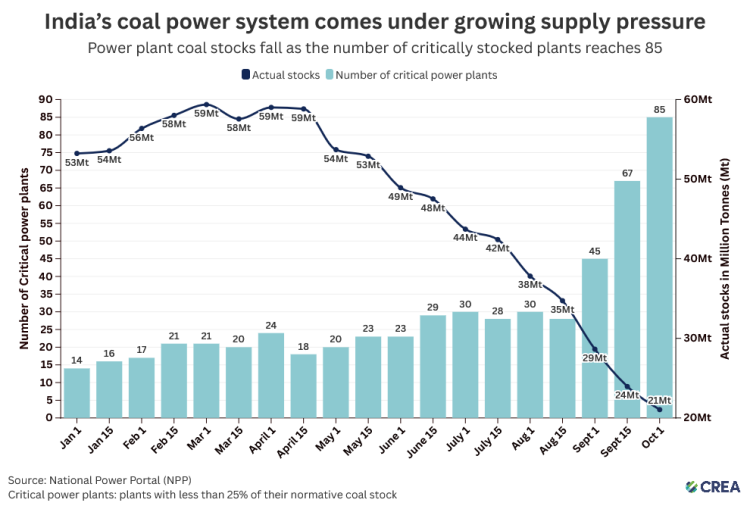
In Q2 FY2026-27, electricity generation increased 11% year-on-year, with renewable generation showing strong growth. Coal generation remained high, keeping coal consumption elevated even as power-plant stocks declined through the quarter. By 1 October, 85 plants had coal stocks below 25% of their normative requirement, highlighting growing pressure on the coal supply chain.
Key highlights
Demand
- Peak electricity demand reached 270 GW on 16 July 2026, 18% higher than the peak recorded during Q2 FY2025-26 (230 GW).
- During 62 of the 92 days in Q2 FY2026-27, the daily peak occurred during solar generation hours.
- Uttar Pradesh and Maharashtra recorded the highest state-level peak demand at 27 GW, followed by Gujarat (23 GW) and Tamil Nadu(20 GW).
Generation
- India's electricity generation increased by 11% year-on-year during Q2 FY2026-27, reaching 536 billion units (BU).
- Solar remained the fastest-growing major source of electricity generation in Q2, increasing by 39% year-on-year, compared with 29% for wind and 26% for nuclear. Hydropower generation declined by 20% over the same period.
- Solar output again reached a new daily record, with 705 MU generated on 30 September, surpassing the previous record in Q1 FY2026-27.
- Renewable electricity generation (excluding large hydro) crossed 100 BU for the first time, reaching 101 BU, while combined non-fossil generation reached a record 177 BU, up from 163 BU in Q2 FY2025-26.
- Coal and lignite contributed 351 BU (around 66% of total generation), compared to 65% (312 BU) in Q2 FY2025-26, up 12.5% year-on-year.
- Combined non-fossil generation (renewables, hydropower and nuclear) reached a record 177 BU, up from 163 BU in the previous year.
Coal consumption, dispatch, stock and critical power plants
- Coal consumption in power plants remained around 79 million tonnes (Mt) per month from June through September.
- Coal supply did not keep pace with this high level of consumption. Coal dispatch to power plants declined from 74 Mt in May to 66 Mt in August, while average freight train coal rake loading fell from around 290 rakes per day in June to 280 in August.
- Coal stocks continued to fall, reaching 21 Mt by 30 September, just 36% of the normative requirement.
- Plants with coal stocks below 25% of their normative requirement increased from 32 on 22 August to 84 by 30 September and 85 by 1 October.
Energy storage
- About 9.1 GWh of India's battery energy storage systems (BESS) are currently operational; around 3 GWh is expected to be commissioned by December 2026.
- As of August 2026, tenders for approximately 290 GWh of storage capacity have been issued, including 142 GWh of pumped storage projects (PSP) and 151 GWh of BESS.
- During nighttime peak demand, storage contributed up to 5.5 GW, up from 4.1 GW in the previous quarter (Q1 FY2026-27), meeting around 1-2% of national electricity demand.
Plant load factor
- For Q2 2026-27, India's Plant Load Factor (PLF) for coal stands at 68%, lignite at 51%, gas at 18%, nuclear at 82%, large hydro at 50%, solar at 18.3%, wind at 37%, and small hydro at 44%.
Installed capacity
- As of August 2026, India's total installed capacity stood at 555 GW. Coal remained the largest contributor at 224 GW, followed by solar (168 GW), wind (59 GW), and large hydro (52 GW).
- Non-fossil fuel sources (solar, wind, large hydro, other renewable energy, and nuclear) now account for approximately 55% of total installed capacity.
Capacity additions and retirements
- Renewables led capacity additions in Q2 2026-27, with 7 GW added, compared with 0.8 GW of thermal.
- About 648 MW of thermal power capacity (440 MW coal-based and 208 MW gas-based) were retired in Q2 2026-27.
Renewable energy curtailment
- Despite record renewable generation, significant volumes of renewable electricity continued to be curtailed because of grid and operational constraints.
- During July and August of Q2 FY2026, approximately 1835 million units (MU) of renewable energy generation was curtailed (1462 MU solar and 373 MU wind).
Source-wise installed electricity generation capacity in India
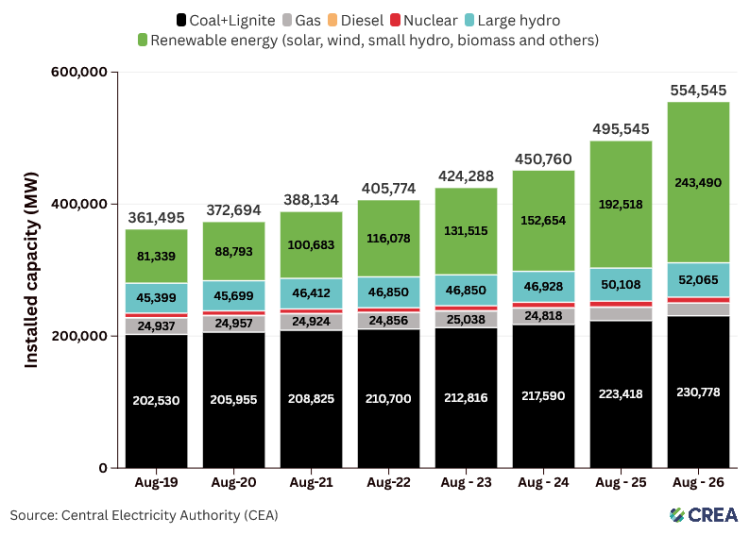
- India's installed power capacity reached 555 GW at the end of August 2026, up 12% from August 2025, 23% from August 2024, and 31% from August 2023.
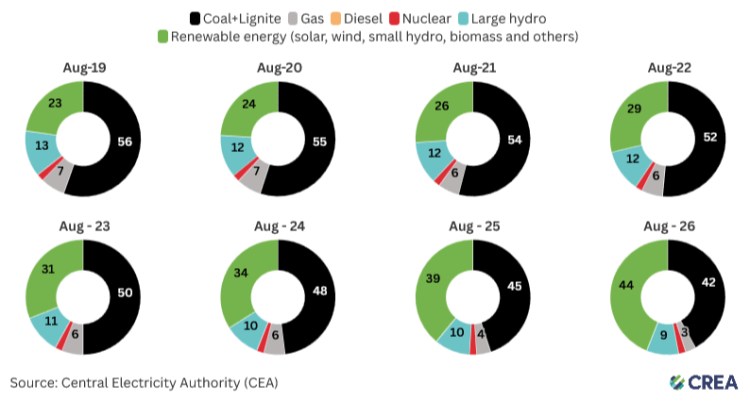
- Coal and lignite remained the largest installed sources at 231 GW (42%), though their share has steadily declined from 56% in 2019 and 45% in 2025.
- Renewable energy (excluding large hydro) grew the fastest, rising to 243 GW (44%) in August 2026 from 193 GW (39%) in August 2025, 153 GW (34%) in August 2024, and just 81 GW (23%) in August 2019.
- Solar drove much of this expansion, reaching 168 GW (30%) of total installed capacity.
- Large hydro capacity stood at 52 GW (9%), while gas declined to 19 GW (3%). Nuclear remained at 8.8 GW (2%).