Next-generation geothermal drilling has entered a new era: wells are reaching greater depths, encountering higher temperatures, and delivering performance that was not possible just a few years ago. While these advances are often enabled by improved subsurface understanding, one of the most important drivers of progress is the drilling technology itself. A key contributor to this shift is the polycrystalline diamond compact (PDC) drill bit, a technology long used in the shale industry and now being leveraged and adapted for geothermal drilling applications like those in Fervo Energy's greenfield development, Cape Station, in Milford, Utah.
Historically, traditional geothermal wells were drilled using roller-cone bits, which fracture rock by crushing it under high force. PDC bits take a different approach. Built with ultra-strong synthetic diamond cutters sintered with tungsten carbide, PDC bits use a fixed-cutter design that shears rock continuously rather than crushing it. This cutting action requires less force to achieve rock failure, enabling faster drilling while reducing mechanical stress on the drill string. The result is improved drilling efficiency, longer bit life, and lower overall well costs - benefits that become more pronounced as wells get deeper and hotter.
Each individual cutter is a feat of materials engineering. Most PDC cutters used in U.S. drilling are manufactured domestically, including in Salt Lake City, Utah. Synthetic diamond grit - derived from carbon powder - is combined with a tungsten carbide substrate and placed inside a high-pressure press. The material is then subjected to roughly one million pounds per square inch of pressure and temperatures at roughly 2,800°F for several minutes. Under these extreme conditions, the diamond particles bond together and to the substrate, forming an ultra-hard cutting surface capable of withstanding intense downhole environments. Each drill bit contains dozens of these cutters working together to shear through rock.
Improvements in cutter geometry, bit design, and materials science have enabled PDC bits to operate in harder rock and higher temperatures than earlier generations - conditions typical when drilling into geothermal reservoirs. And while geothermal did not initially benefit from these advances, recent breakthroughs are closing that gap.
Drilling deeper into the data
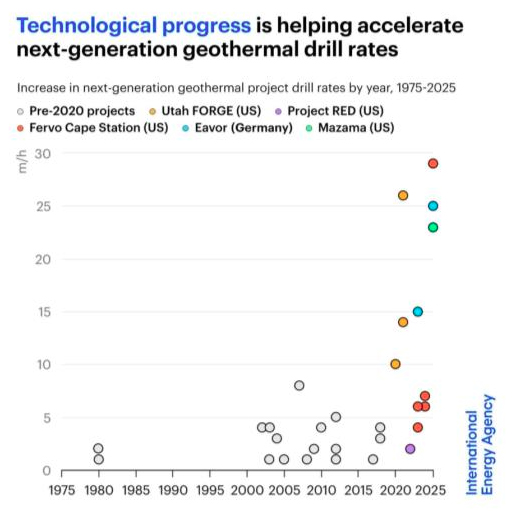
According to the International Energy Agency (IEA), the crossover of oil and gas technologies into geothermal is helping reduce costs and accelerate project development. Recent next-generation geothermal wells are outperforming earlier projects, with drilling rates for some operators nearly doubling. These results reflect the application of modern drilling tools and techniques to geothermal, bringing decades of innovation to a sector that historically relied on older assumptions and equipment.
Drilling remains one of the largest cost drivers in geothermal development. Faster drilling reduces these capital costs, shortens timelines, and lowers execution risk, making geothermal projects like Cape Station more competitive and scalable. Interestingly, many geothermal cost models are still based on historical drilling performance, which does not account for modern tools like PDC bits. As these technologies become standard in geothermal operations, those assumptions are rapidly becoming outdated.
Looking ahead
The adoption of advanced drilling technology represents a step-change opportunity for geothermal. By applying proven innovations from across the energy sector, geothermal is moving closer to realizing its full potential as a source of carbon-free, always-on power. Although modern drill bits may seem like a small component of the system, their impact on speed, cost, and performance is reshaping what is possible for next-generation geothermal.