Last week, we announced the results of our Sawtooth 7 well. Sawtooth 7 was the ninth well drilled for our Cape Phase II project and represents a major leap forward in our drilling complexity and performance. It was drilled to 19,448 feet, with a casing diameter of 8 5/8", a 7500 foot lateral and to 460F. All in 21 days. This well is part of our third generation of wells, the Fervo 3.0 design, and is part of our continual evolution of hotter and more productive wells. It's worth examining where this well fits in our overall strategy to understand why it was such an important milestone.
At Fervo, we constantly think about new technology development and how to push the frontier of innovation. One area we are constantly working on is drilling hotter and deeper wells. This will enable Geothermal Anywhere, a goal the industry has long pursued where geothermal is the cheapest form of electricity period, in any location. Currently, Fervo is beginning our project pipeline in areas called near-field enhanced geothermal or areas with above average geothermal gradients. We are starting here because these projects, with favorable geology, are already economic today and present an opportunity of 10s of GWs in the United States alone. But it will also enable us to advance the technology so we can push to ever hotter and deeper resources, including a class of resource called "supercritical" geothermal.
Getting to supercritical is a massive technological undertaking, likely on the order of complexity as SpaceX's stated goal of colonizing Mars. So it's useful to look at how SpaceX is tackling that challenge to draw lessons for Fervo and the broader geothermal industry.
SpaceX Technology Roadmap
Elon Musk, from the very beginning, has set a mission for SpaceX to expand to Mars. However, the first rocket SpaceX ever built, the Falcon 1, contained a single booster stage engine, the Merlin, and was categorized as a small lift launch vehicle. This rocket was only capable of reaching Low Earth Orbit with a payload of 670 kg. So why would a company with a mission to go interplanetary spend tons of time and resources building a rocket that doesn't come close to achieving that objective?
The answer, of course, underpins not only SpaceX strategy but also is the roadmap for every significant technology revolution of the last century: the power of learning while doing.
The Falcon 1 was not the end state of SpaceX design, but it was a minimum viable product, that allowed them to capture real world launch data from the earliest days of the company. Many of those launches were not successful. Famously, the first three Falcon 1 launches all failed until finally, after two and a half years of work, the fourth test was successful. SpaceX went on to do a fifth and final launch, delivering a modest amount of revenue for the Falcon 1 platform, especially relative to launch costs, but it let them collect the data to jump to the next generation of rocket.
The Falcon 9 was successfully launched in 2010 and built directly on the Falcon 1 data. Even the name "9" shows how directly this generation of rocket built on the last. The Falcon 9 uses the same Merlin Engine as the Falcon 1. It just uses 9 of them. SpaceX also built a sustainable revenue stream on the Falcon 9 platform, using it as a launch vehicle for a wide array of commercial and government contracts.
Every single launch provided an opportunity for innovation, data collection, and testing. SpaceX continued to have some high profile failures, but each failure also provided valuable data to improve the system. Ultimately, learning by doing unlocked the next generation, the Falcon Heavy, with 27 Merlin Engines, and continued to dramatically lower launch costs. Additionally, as launch costs dropped, new revenue streams were identified. The current cash cow for the entire company, Starlink, came from a realization that falling launch costs opened the door for a radically different type of satellite internet service that SpaceX could build itself.
The pillar of the Mars strategy is the Starship, a rocket system with a payload more than two orders of magnitude greater than the original Falcon 1. Despite SpaceX's mission to unlock interplanetary travel, they didn't even begin testing of the Starship until 2023, over 20 years after the founding of the company. But SpaceX spent that 20 years building the foundation, from data and technology, to capital and revenue, for the Starship. By 2023, SpaceX had conducted over 200 successful launches, brought in nearly $10 billion in fundraising and over $15 billion in estimated revenue since inception. This was the foundation upon which the Mars program was launched.
Lessons
SpaceX trajectory is a masterclass in Learning While Doing. Three key pillars undergirded their strategy:
- Start with a minimum viable product, but one that solves the technical challenges relevant to the ultimate goals, and brings in revenue, however modest.
- Standardize and modularize your technology roadmap so data from the MVP can be used to improve and update performance.
- Figure out how to make revenue every step of the journey.
The Falcon 1 was critical from both a technology and business standpoint. Testing the exact engine, the Merlin, that would be used in the next generation, and collecting real world flight data were both critical to future success. Additionally, courting a customer, even at the earliest launches, was critical to ensure SpaceX was actually building a product that customers would pay for and met the right risk profile to secure a contract.
As SpaceX continued to expand, it iteratively improved on the MVP, directly drawing on past successes and failures to test designs. No leap in technology in and of itself was categorically different than what had come before it, but 20 years of iteratively better designs unlocked improvements that were multiple orders of magnitude more efficient.
Finally, the money has to come from somewhere. Estimates for Starship development costs are north of $15 billion. SpaceX has been able to tap the private and public markets to fund this program because they now have demonstrated a 20 year history of not only delivering on technical products but also in turning those into revenue streams. Raising the $15 billion needed for the program would not have been possible if they had not proven an ability to generate revenue on every step of the journey.
The Geothermal Parallel
Much like SpaceX's long term mission of interplanetary travel, Fervo holds a similar ambition of Geothermal anywhere. We believe this moonshot will be unlocked by being able to drill so deep and so hot that virtually any geology, anywhere in the world, will be economic. However, much like the Starship example, starting with the end state and trying to solve all the various technology challenges all in one go would be incredibly challenging. So Fervo has opted to take a learning by doing path that parallels SpaceX.
Project Red was our first pilot. Rather than try to drill a super hot or super deep concept right out of the gate, we completed a project in a category called "near-field Enhanced Geothermal Systems" (NF-EGS). This meant going to a location that was adjacent to a producing geothermal site, so the geothermal gradient was higher, even though the permeability in the part of the field we had selected did not support prior development with conventional technology.
We also carefully scoped the engineering design and field development plan to achieve the right goals. We evaluated what would allow us to launch an MVP immediately, without having to wait for lengthy technology development, but also prove critical aspects of the Fervo design that would enable us to take the right steps to geothermal anywhere. The end result was the Fervo 1.0 well design: about 8,000 feet in vertical depth, over 3,000 feet laterals, with 5" diameter casing and a target temperature of 350F. Not an ideal project, and not even an economic one, but it was an MVP we could get started on to begin learning by doing.
Fervo launched Project Red in 2021 and found ourselves dealing with challenges and failures that closely mirrored the early Falcon 1 days. The first well we ever drilled as a company was planned to be an 8,000 foot monitoring well. After about a month we were only about 1700 feet deep and we took a pause. Some of the tech bets we had made weren't working out, so we went back to the drawing board and used the data from that setback to drive a new plan.
A few months later we were back at it and our next attempt at a deep vertical well went fantastic. Our next setback was failure of a subcomponent on our production casing during well stimulation on our second-ever horizontal well. This was yet again something that set us back by months but allowed us to develop the tools needed to overcome that challenge, tools that would come in handy time and again in the future. This is the whole purpose of learning by doing.
By the time we commissioned Project Red in 2023, the first-ever Fervo 1.0 design, we were already drilling the Fervo 2.0 design at Project Cape. Now we were at 9000+ foot vertical wells, 5000 foot laterals, 7" casing and 400F target temperature. We have had our share of setbacks and challenges of the Fervo 2.0 design, but as of today, we have drilled and completed 25 Fervo 2.0 wells. Our hypothesis on cost per foot and power output per well have been strongly supported by operational data, and we are now done drilling our first sets of Fervo 3.0 designs. This week, we announced a new record in drilling results. The Sawtooth 7, our 9th total Fervo 3.0 well, was drilled in just 21 days to a depth of 19,448 feet. Our baseline at Project Red was 70 days to a depth of 11,220 feet.
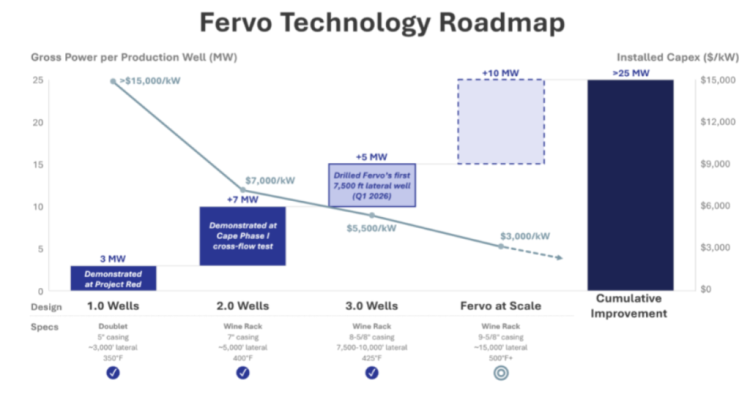
In just the span of three years, we have more than doubled our lateral length, proven we can drill far deeper and hotter, and increased the cross sectional area of our wells by nearly threefold. This evolution follows very closely the roadmap of moving from Falcon 1, to Falcon 9, to Falcon Heavy and beyond. Each step forward adds new risks and presents the opportunity for new trials. There will always be some failures, but the data collected and the technology tested drives a process of learning by doing that unlocks transformative results.
Superdeep and Superhot
To fully unlock geothermal anywhere, technology that enables super deep and super hot EGS development will be required. This will be an enormous technology endeavor, on par with the challenge of interplanetary transport. In Heat Extraction from SuperHot Rock Technology Development, Dr. Trenton Cladouhos outlines the massive scientific undertakings needed to unlock superhot geothermal. Currently, huge knowledge gaps exist on performance of reservoirs under superhot conditions, including fluid-rock interaction, geomechanical behavior of rocks in the brittle ductile transition zone, and rates of geochemical reactions. Downhole tools do not yet exist to log the wells, power drill bits, and drill directionally. The cement, casing and plugs needed for well stimulation currently are not designed to handle the extreme temperatures of superhot.
The challenge of pushing to superhot will involve comparable scientific effort and financial resources to colonizing Mars. So we should adopt the same formula for success that SpaceX has.
Pushing to commercially develop Superhot in a single step, rather than following the SpaceX pathway of commercializing enabling technologies, carries significant risk. Frequently ambitious scientific projects run into an early roadblock, political winds shift, and funding is no longer available to pursue the ambitious target. Government funded projects in the past often follow a pattern of jumping for a moonshot, running into operational challenges, and then losing the political will to continue in the face of those challenges. In these situations, without independent revenue, projects get stalled out or cancelled and the learnings are lost to time.
For a multi-decade, ambitious moonshot to succeed, it must have access to multiple funding sources to continue progress throughout the political and economic cycles. The key to what SpaceX has unlocked is a revenue and funding cycle that enables success for every single intermediate milestone on the journey to the moonshot. This is what the geothermal industry must do.
The Future of Geothermal
Fervo has taken the SpaceX roadmap and made it work for geothermal. We developed an MVP in 2023 with the commissioning of Project Red. We standardized well designs and power plant designs in the GeoBlock to ensure that iterative improvements can be made cycle to cycle. We have carefully selected a project pipeline that allows us to move from near-field EGS into deeper and deeper resources, helping ensure we generate revenue every single step of the journey to the moonshot.
Fervo has made remarkable progress in recent years. Drilling to 11,000 feet total depth and 350F in 2022 at Project Red took us 70 days. Today, we have surpassed a new milestone: the Sawtooth 7 reached over 19,000 feet and 460F in just 21 days. In just the span of a few years, Fervo has improved drilling rates by approximately 600%, pushed over 100F hotter, and nearly 5X the output per well. And Fervo has developed a road map so each step of the journey provides the revenue to fund the next.
If that's what we have done in just 4 short years, what will we do in the next 4? The next 10?
The holy grail is closer than you think, and Fervo has the plan to get there.
Forward-Looking Statements
This post contains "forward-looking statements" within the meaning of Section 27A of the Securities Act and Section 21E of the Exchange Act, which involve risks, uncertainties, and assumptions. All statements, other than statements of historical fact, are forward-looking statements. When used in this post, the words "aim," "anticipate," "believe," "continue," "could," "estimate," "expect," "forecast," "future," "guidance," "intend," "may," "model," "outlook," "plan," "positioned," "potential," "predict," "project," "seek," "should," "target," "will," "would," and similar expressions (including the negative of such terms) are intended to identify forward-looking statements, although not all forward-looking statements contain such identifying words. Although Fervo believes that the expectations and assumptions reflected in its forward-looking statements are reasonable as and when made, they involve risks and uncertainties that are difficult to predict and, in many cases, beyond Fervo's control. Accordingly, forward-looking statements are not guarantees of future performance, and Fervo's actual outcomes could differ materially from what Fervo has expressed in its forward-looking statements.
Factors that could cause the outcomes to differ materially include (but are not limited to) the following: risks related to expanding our geothermal operations and accessing new markets; challenges in maintaining compliance with extensive environmental regulations and permitting requirements; uncertainties in forecasting future operational results and growth due to economic conditions and market demand; compliance with environmental regulations and climate change initiatives impacting operational costs; inherent risks in the geothermal industry, including potential operational disruptions and associated liabilities; the influence of consumer preferences, government policies, and competition on the demand for geothermal energy; risks associated with fluctuations in energy prices and material costs; dependence on a complex supply chain and successful maintenance of our geothermal infrastructure; financial performance influenced by fluctuations in interest rates, capital availability, and other market conditions; capacity actually constructed or for which we enter power purchase agreements under non-binding agreements, like the Geothermal Framework Agreement; exposure to legal proceedings and claims arising from our business operations; protecting our brand reputation and facing potential negative public perception; negative public perception and political opposition impacting our ability to secure regulatory approvals and market acceptance; the successful and timely execution of our growth strategy, with risks of delays or failures; reliance on key personnel and the potential impact of labor costs and workforce challenges; heavy reliance on technology systems and potential cybersecurity threats; global economic and political conditions affecting our operations, supply chain, and customer demand; the risk that our estimates of capacity potential and heat initially in place are inaccurate or that we are unable to produce quantities of electrical energy commensurate with such estimates; and other risks and uncertainties, including those set forth under "Risk Factors" in Fervo's Registration Statement on Form S-1/A, filed with the Securities and Exchange Commission (the "SEC") on May 11, 2026, and Fervo's other filings with the SEC.
In light of these factors, the events anticipated by Fervo's forward-looking statements may not occur at the time anticipated or at all. Moreover, Fervo operates in a very competitive and rapidly changing environment, and new risks emerge from time to time. Fervo cannot predict all risks, nor can it assess the impact of all factors on its business or the extent to which any factor, or combination of factors, may cause actual results to differ materially from those anticipated by any forward-looking statements it may make. Accordingly, you should not place undue reliance on any forward-looking statements. All forward-looking statements speak only as of the date of this post or, if earlier, as of the date they were made. Fervo does not intend to, and disclaims any obligation to, update or revise any forward-looking statements unless required by applicable law.
By: Tim Latimer, CEO and Co-Founder, Fervo Energy