Highlights
- Standardized definitions and metrics are needed for meaningful comparison.
- Multidomain modeling and limited validation reduce confidence in results.
- Cost, financing, and ownership structures remain major deployment barriers.
- Coordinated advances across modeling, data, and planning are critical.
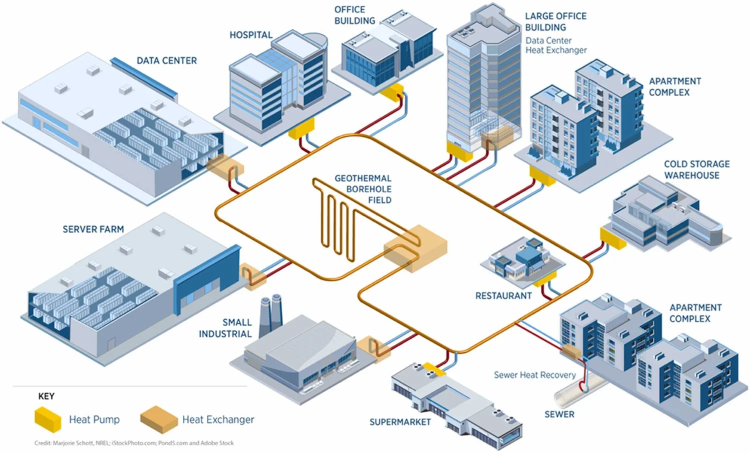
Fig. 1. An example of a geothermal thermal energy network with a shared single-loop ambient distribution system connecting multiple buildings (e.g., hospital, office buildings, apartment complex) with distributed energy transfer stations. The network integrates subsurface geothermal exchange and bidirectional heating and cooling across connected loads. Image courtesy of Marjorie Schott, National Laboratory of the Rockies.
Abstract
Geothermal thermal energy networks (TENs) offer a pathway to low-temperature, multisource heating and cooling systems that integrate geothermal exchange, waste heat recovery, and seasonal storage. This paper synthesizes 10 recurring challenges that limit comparable modeling, techno-economic assessment, and scalable deployment of geothermal TENs. By consolidating insights across disciplines and early deployments, this work identifies barriers and highlights priorities for advancing TEN analysis and implementation, including standardized definitions, cross-sector planning frameworks, validated component models, and improved field data. These insights support consistent evaluation and informed decision-making for TEN planning and deployment.
Research paper by Scott Mello, Juliet Simpson, Whitney Trainor-Guitton, Nicholas Long
Source:https://www.sciencedirect.com/science/article/pii/S2352484726007638